

Pneumatic Solenoid Valves - SY Series
Power Fluid SY Series, New 5 Port Pneumatic Solenoid Valves
Improved Performance, Multiple Purpose
Top 5 Brand In China Market
Features
-
Durable Brass Construction: Resists corrosion and ensures longevity even in harsh environments.
-
Fast Response Time: Operates within 0.1 seconds for precise control in fast-paced processes.
-
Wide Voltage Compatibility: Supports 12V, 24V, and 220V systems for versatile integration.
-
High Flow Capacity: Minimizes pressure drop with optimized internal design.
-
Manual Override Option: Allows manual operation during power outages or maintenance.
-
Compact and Modular Design: Easy to install and replace in confined spaces.
Application
-
Automotive Manufacturing: Controls pneumatic tools, clamping systems, and robotic arms for precise assembly.
-
Food & Beverage Processing: Manages packaging equipment and conveyor systems with reliable performance.
-
Medical Equipment: Regulates air supply in dialysis machines and laboratory automation systems.
Summary
The SY Series stands out for its robust construction and efficient operation. Its brass body and advanced engineering ensure minimal downtime and consistent performance. The valve’s quick response and high flow capacity make it suitable for applications requiring split-second accuracy. In automotive manufacturing, it enhances precision in assembly lines; in food processing, it maintains hygiene and reliability. For medical devices, its stability and accuracy are critical. The SY Series reduces energy consumption through efficient air control, lowers maintenance costs with durable components, and extends equipment lifespan. Its adaptability to various industries solidifies its position as a versatile solution for modern automation needs.
Why Choose Our Pneumatic Solenoid Valves?
Pneumatic Solenoid Valves are the heart of automated industrial systems, responsible for the precise directional control of compressed air to actuate cylinders and tools. Choosing our pneumatic series means opting for high-speed performance and exceptional reliability in fast-cycle manufacturing environments. Our valves are designed to synchronize perfectly with PLC controllers, ensuring smooth and repeatable machine movements. Whether you are using the versatile 4V series or the compact SY type, our valves provide the durability needed to minimize downtime and maintain peak productivity in any assembly line or packaging facility.
 |
Advantages of Our Pneumatic Solenoid Valves
Special structure design
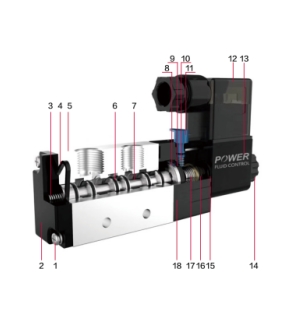
1. Cross slot pan screw
2. Back cover
3. Spring
4. Anomalous seal
5. Valve body
6. Fat ring
7. Valve body
8. Piston
9. Y ring
10. Spring
11. Manual override
12. Terminal
13. Coil
14. Coil nut
15. Connecting part
16. O ring
17. Plunger
18. Piloted valve base
Advantages:
-
Premium-Quality Materials: Superior brass construction ensures longevity and corrosion resistance.
-
Customizable Settings: Adjustable pressure, voltage, and flow rate settings to match specific needs.
-
ISO-Certified Production: Meets global quality standards for safety and performance.
-
Extended 3-Year Warranty: Provides confidence in product durability and reliability.
-
Expert Support Team: Offers installation guidance, troubleshooting, and maintenance tips.
FAQ
Q1: How does the SY Series valve handle high humidity environments?
A1: The brass body and sealed components resist moisture, ensuring reliable operation in humid conditions.
Q2: What is the maximum operating pressure?
A2: Designed for pressures up to 150 psi, with safety features to prevent over-pressurization.
Q3: Is installation complicated?
A3: No; it features universal connectors and a modular design for easy integration.
Q4: How often should the valve be serviced?
A4: Recommended annual inspection with seal replacement every 2–3 years under normal use.
Q5: What is the typical lifespan?
A5: With proper maintenance, it can function reliably for over 5 years in industrial settings.
Q6: Does it generate noise during operation?
A6: Engineered for quiet operation, producing minimal sound even during rapid cycling.
Q7: Is it compatible with non-lubricated air systems?
A7: Yes; its design accommodates both lubricated and dry air systems.
Q8: How does it prevent energy waste?
A8: By minimizing air leakage and optimizing flow, it reduces compressor workload and energy use.